


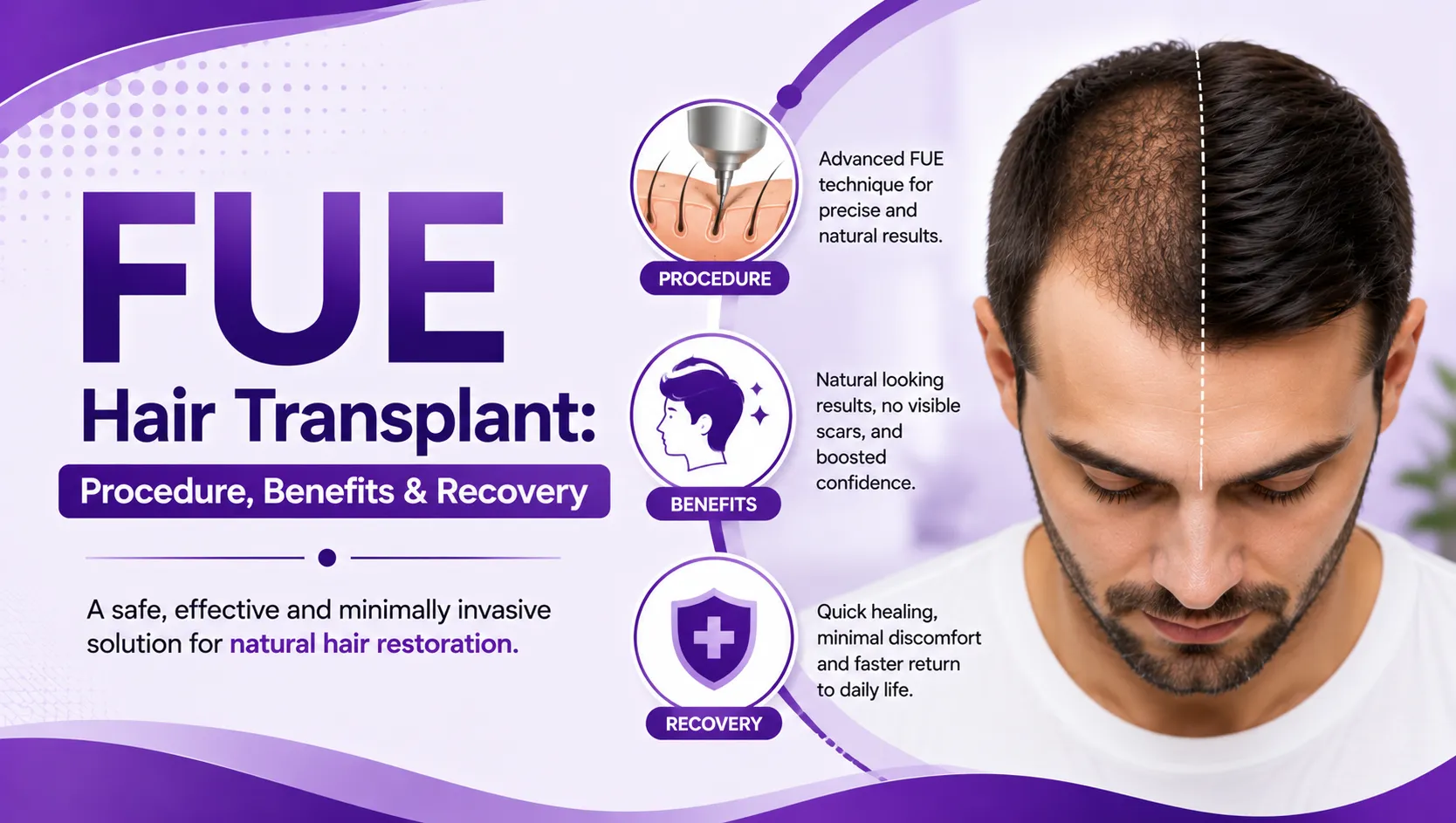
FUE Hair Transplant: Procedure, Benefits & Recovery
Hair loss can affect both your appearance and your confidence. Whether you're noticing a receding hairline, thinning hair, or bald patches, finding the right treatment can feel overwhelming. Fortunately, modern hair restoration techniques have made it possible to achieve natural-looking, long-lasting results.
One of the most advanced and widely performed procedures today is the FUE (Follicular Unit Extraction) hair transplant. This minimally invasive technique restores hair by transplanting healthy hair follicles to thinning or bald areas with minimal scarring and a faster recovery than traditional methods.
In this blog, we'll explain how an FUE hair transplant works, its benefits, recovery process, possible risks, expected results, and whether it's the right option for you.
What Is an FUE Hair Transplant?
FUE (Follicular Unit Extraction) is one of the most advanced hair restoration techniques available today. During this procedure, individual hair follicles are carefully extracted from a donor area, usually the back or sides of the scalp, where hair is naturally more resistant to hair loss. These healthy follicles are then transplanted into thinning or bald areas to restore natural hair growth.
Unlike traditional hair transplant methods that involve removing a strip of scalp, FUE uses a specialized micro-punch tool to extract individual hair follicles. This minimally invasive approach leaves tiny, nearly invisible scars and generally offers a faster and more comfortable recovery.
Once transplanted, the healthy hair follicles continue to grow naturally in their new location. Since they are taken from areas that are typically resistant to hair loss, the results are long-lasting and can provide a natural-looking improvement in hair density.
How Does the FUE Hair Transplant Procedure Work?
Every FUE hair transplant is carefully planned to create a natural-looking hairline and achieve the best possible results. Although the exact steps may vary depending on your hair loss pattern, the process generally includes the following stages.
Step 1: Initial Consultation
Your journey begins with a detailed consultation.
During this visit, your surgeon will:
- Assess your hair loss pattern
- Examine the donor area
- Review your medical history
- Discuss your expectations
- Estimate the number of grafts required
- Design a personalized treatment plan
This evaluation helps determine whether FUE hair transplant is the best option for you.
Step 2: Preparing the Donor Area
On the day of the procedure:
- The donor area is trimmed or shaved.
- Local anesthesia is administered to ensure comfort.
- The donor and recipient areas are marked according to the treatment plan.
Because the procedure is performed under local anesthesia, patients remain awake but comfortable throughout the surgery.
Step 3: Follicular Unit Extraction
Using a specialized micro-punch instrument, the surgeon carefully removes individual hair follicles from the donor area.
Each graft typically contains one to four hairs and is preserved in a special solution to maintain its viability before implantation.
Careful extraction minimizes damage to the follicles and helps improve graft survival.
Step 4: Recipient Site Creation
Tiny openings are created in the thinning or bald areas of the scalp.
The angle, depth, and direction of these sites are carefully planned to mimic natural hair growth and create a realistic hairline.
Proper placement is one of the most important factors in achieving natural-looking results.
Step 5: Hair Graft Implantation
The harvested follicles are individually placed into the recipient sites.
This step requires precision to ensure:
- Natural hair direction
- Appropriate density
- Balanced hairline design
- Even distribution of grafts
Depending on the number of grafts required, the procedure may take several hours.
Most patients return home the same day.
Who Is a Good Candidate for Hair Transplant FUE?
While FUE is an excellent option for many individuals, not everyone is an ideal candidate.
You may benefit from FUE hair transplantation if you:
- Have male pattern baldness
- Experience female pattern hair thinning (in selected cases)
- Have a receding hairline
- Have thinning at the crown
- Need restoration of hair lost due to injury or scars
- Have healthy donor hair at the back or sides of the scalp
- Are in good overall health
- Have realistic expectations
A consultation with an experienced hair transplant surgeon is essential to determine whether you have enough donor hair to achieve your desired results.
Benefits of FUE Hair Transplant
The popularity of the FUE hair transplant technique continues to grow because of its many advantages.
Some of the key benefits include:
- Minimally invasive procedure
- No large incision
- No linear scar
- Faster healing compared to traditional methods
- Natural-looking hairline
- Permanent hair restoration
- Less postoperative discomfort
- Suitable for people who prefer short hairstyles
- Minimal downtime
- High graft survival when performed correctly
Because only individual hair follicles are carefully extracted, recovery is generally smoother than older hair transplant techniques.
Recovery After Hair Transplantation FUE
Recovery is an important part of achieving successful results. Most patients recover comfortably by following their surgeon's postoperative instructions.
First 24 to 72 Hours
You may experience:
- Mild swelling
- Redness
- Tiny scabs around transplanted follicles
- Mild tenderness
Sleeping with your head elevated helps reduce swelling during the first few days.
First Week
During the first week:
- Wash your scalp only as instructed.
- Avoid scratching or rubbing the transplanted area.
- Take prescribed medications.
- Avoid strenuous exercise.
Most scabs begin to fall off naturally within 7 to 10 days.
First Month
Don't be alarmed if some transplanted hairs fall out during the first few weeks. This temporary shedding, known as shock loss, is a normal part of the healing process. The hair follicles remain healthy beneath the scalp and will gradually begin producing new hair.
Three to Twelve Months
New hair growth usually begins around three to four months after surgery.
Hair gradually becomes thicker and denser over the following months.
Most patients appreciate their final results between 9 and 12 months after the procedure.
Results: When Will You See New Hair Growth?
Hair growth after an FUE hair transplant happens gradually.
A typical timeline is:
- First month: Temporary shedding of transplanted hair
- Three to four months: Early new hair growth
- Six months: Noticeable improvement in density
- Nine to twelve months: Final results for most patients
Patience is important, as natural hair growth takes time.
Risks and Possible Side Effects
Like any surgical procedure, an FUE hair transplant carries some potential risks. However, complications are uncommon when the procedure is performed by an experienced surgeon and proper aftercare instructions are followed.
Possible side effects include:
- Swelling
- Redness
- Scabbing
- Mild pain
- Itching
- Temporary numbness
- Folliculitis (inflamed hair follicles)
- Infection (rare)
- Uneven growth
- Poor graft survival (rare)
Choosing an experienced surgeon and following postoperative instructions help minimize these risks.
FUE vs FUT Hair Transplant
Both FUE and FUT are effective hair restoration techniques, but they differ in how hair follicles are harvested.
Your surgeon will recommend the most suitable technique based on your hair loss pattern, donor hair availability, and treatment goals.
How Long Do FUE Hair Transplant Results Last?
One of the biggest advantages of FUE hair transplant is that the transplanted follicles are generally permanent.
Since the transplanted follicles come from donor areas that are naturally resistant to hair loss, they usually continue growing for many years, often providing permanent results.
However, untreated natural hair surrounding the transplanted follicles may continue to thin with age. In some cases, medications or additional treatments may be recommended to maintain overall hair density.
How Much Does an FUE Hair Transplant Cost?
The cost of an FUE hair transplant in India typically ranges from ₹35,000 and ₹1,50,000 or more, depending on the extent of hair loss and the number of grafts required. Since every patient has unique hair restoration needs, the final cost varies based on several factors.
These factors include:
- The number of grafts needed
- The extent and pattern of hair loss
- The surgeon's experience and expertise
- The technology and techniques used during the procedure
- The clinic's facilities and level of care
- The location of the clinic
- Whether additional treatments or follow-up care are included
The best way to determine the exact cost is through a detailed consultation. During your visit, the surgeon will assess your scalp, evaluate the donor area, estimate the number of grafts required, and create a personalized treatment plan with a transparent cost estimate.
How to Choose the Right Hair Transplant Surgeon
Choosing a hair restoration surgeon is very important.
Choose a surgeon:
- With significant FUE experience
- Who has natural hairline concepts
- Shows patients FUE before and after
- Uses contemporary FUE instruments and methods
- Creates individualized patient treatment options
- Whose previous patients have good reviews
- Provides thorough post-op care
Your choice of FUE surgeon will have a lasting impact on the outcome of your procedure.
Why Choose Dr. Preeti Yadav for FUE Hair Transplant?
Dr. Preeti Yadav offers personalized solutions for hair restoration. She considers patient's patterns of hair loss and their aesthetic goals.
Patients benefit from:
- Thorough assessments of hair loss
- Planning treatments that best fit their needs
- The newest methods of FUE
- Crafting hairlines that look the most natural
- Patient safety and satisfaction
- Post-op instructions
- Kindness during the entire process
Dr. Preeti Yadav can guide those with hair loss ranging from localized to thinning to receding, along the best options for treatments that will look natural and last.
Conclusion
An FUE hair transplant is one of the most effective and minimally invasive solutions for restoring hair and improving confidence. With minimal scarring, a faster recovery, and natural-looking results, it has become a preferred choice for people experiencing thinning hair or baldness. While new hair growth takes time, the transplanted follicles generally provide long-lasting results when performed by an experienced surgeon.
If you're considering an FUE hair transplant, consult Dr. Preeti Yadav, one of the best plastic surgeons in Gurgaon, for a personalized hair restoration plan tailored to your hair loss pattern and aesthetic goals.
Frequently Asked Questions
1. What is an FUE hair transplant?
An FUE (Follicular Unit Extraction) hair transplant is a minimally invasive hair restoration procedure in which individual hair follicles are extracted from a donor area and transplanted into thinning or bald areas of the scalp to promote natural hair growth.
2. Is an FUE hair transplant permanent?
Yes. The transplanted hair follicles are generally permanent because they are taken from areas of the scalp that are naturally resistant to hair loss. However, existing natural hair may continue to thin over time, so additional treatments may sometimes be recommended.
3. How long does it take to see results after an FUE hair transplant?
Hair growth happens gradually. Some transplanted hairs may shed during the first month, which is a normal part of the healing process. New hair usually starts growing after 3 to 4 months, with noticeable improvement by 6 months and final results typically visible within 9 to 12 months.
4. Is an FUE hair transplant painful?
The procedure is performed under local anesthesia, so you should not feel pain during the surgery. Mild soreness, swelling, or discomfort after the procedure is normal and usually improves within a few days with prescribed medication.
5. How much does an FUE hair transplant cost?
The cost of an FUE hair transplant varies depending on factors such as the number of grafts required, the extent of hair loss, the surgeon's expertise, the technology used, and the clinic's location. A consultation is the best way to receive an accurate treatment plan and cost estimate.
6. Who is a good candidate for an FUE hair transplant?
An FUE hair transplant is suitable for individuals with male or female pattern hair loss, a receding hairline, thinning hair, or bald patches who have sufficient healthy donor hair and are in good overall health. A detailed consultation helps determine whether the procedure is right for you.