

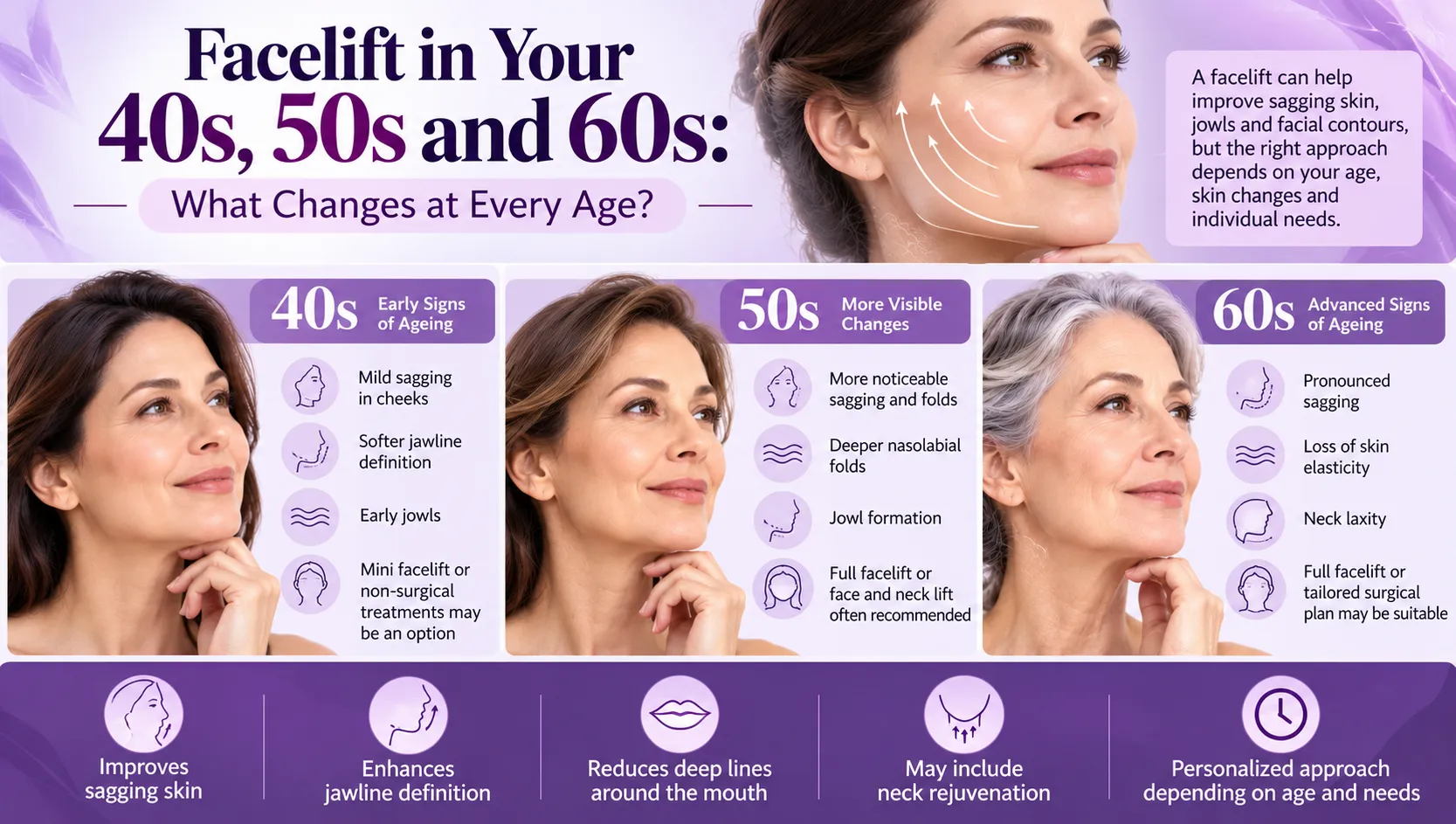
Facelift in Your 40s, 50s and 60s: What Changes at Every Age?
Facial ageing varies from person to person. While some people may notice sagging skin and changes in facial contours in their 40s, others may consider a facelift in their 50s or 60s. The right time for facelift surgery depends on several factors, including facial structure, skin elasticity, overall health, and individual aesthetic goals.
In this blog, we’ll explore how facelift surgery approaches differ across your 40s, 50s, and 60s, the differences between a mini facelift and a full facelift, and the key factors to consider before undergoing the procedure.
What Is a Facelift?
A facelift, scientifically referred to as rhytidectomy, is a type of cosmetic surgery used to correct facial signs of aging, especially in the areas below the chin.
A facelift can be effective in correcting:
- Cheek sags in the lower face and cheeks.
- The jowls in the jaw area.
- Deep lines around the mouth.
- Reduced jawline definition.
- Looseness of skin in the neck, when this part is included in the procedure.
It should be noted, though, that a facelift cannot reverse natural aging or cure certain conditions, like skin color changes and superficial wrinkles.
Facelift in Your 40s: Addressing Early Signs of Ageing
As you reach your 40s, you might start seeing some changes in your facial structure. You could see that your cheeks aren't as firm as they used to be, your jawline is a little softer and you could have developed jowls.
Are there any types of facelifts you could do in your 40s?
There is a type of facelift that would be right for some people in their 40s who experience slight to medium sagging, especially on their lower face. Usually, it is less invasive than a traditional facelift.
But surgery isn't necessarily what you need. If your problem is fine lines and some volume loss, then perhaps you can opt for non-surgical procedures.
Important note: The point of a facelift procedure in your 40s is to correct the existing sagging, not to prevent yourself from aging further.
Facelift in Your 50s: Improving Jowls and Jawline Definition
It may also be that during this decade, there will be visible changes to the skin's elasticity, fat distribution in the face and tissue structure that provides the needed support. You may notice deeper nasolabial folds, jowl formation, and looseness around the neck area.
What facelift methods are recommended for your age?
A full facelift may be an option if the sagging is present in different parts of the lower face. It is also possible that if the neck has loose skin or bands, a combination of the face and neck lift procedure will bring better results.
There are also non-invasive treatment methods that can help you if your problem is connected with fine lines, poor skin texture, and lack of volume. However, fillers and skin tightening procedures cannot fix tissue sagging as efficiently as surgical procedures do.
Important note: The facelift procedure planning in your 50s should include the correction of the jawline, lower face, and neck.
Facelift in Your 60s: Comprehensive Facial Rejuvenation
At 60 years old, facial ageing can be accompanied by more severe jowls, deep lines, decreased elasticity of the skin, and loosening of the neck. Changes in the volume of the face can also have an effect on how fresh or defined one looks.
Which type of facelift can be done at age 60?
If there is noticeable looseness, a traditional or full facelift or even a combined face and neck lift can be recommended. In accordance with the patient’s requirements, other operations might be performed in addition to a facelift, for instance, blepharoplasty or volume-restoring procedures.
It is not the age that disqualifies patients from undergoing a facelift operation. Overall health, healing abilities, smoking, medication use and medical conditions are key factors in deciding whether it is possible to do surgery.
Main point: Facelift in your 60s must include a thorough pre-surgical evaluation, proper expectations and enough recovery time.
Facelift in Your 40s, 50s and 60s: A Quick Comparison
These are general patterns, not fixed rules. Someone in their 40s may need more extensive correction than someone in their 60s, depending on their facial anatomy and skin laxity.
Mini Facelift vs Full Facelift: Which Is Right for You?
Whether one goes for a mini facelift or a traditional facelift would be determined by how much sagging there is and the areas that require correction.
- Mini facelift: This is normally done for certain people who have a bit of sagging in their lower face along with minimal jowling. The procedure done is normally a bit more conservative than the full facelift.
- Full facelift: This is often recommended for cases of more noticeable or extensive sagging.
- Face and neck lift: This might be recommended in situations where there is loose neck skin along with changes in the jawline definition.
A minor operation is not necessarily a good thing as major surgery is not always a requirement either.
What to Expect During Facelift Recovery
There are a number of factors that will influence the recovery period from the procedure.
In the initial stages after the operation, there might be swelling, bruising, tightness and altered skin sensation. These usually get better over time in the coming weeks.
The following are a few essential considerations for your recovery process:
- First week: Get plenty of rest, adhere to wound care guidelines and go for the follow-up visits.
- Second and third weeks: There might be an improvement in bruising and swelling, though there could still be swelling.
- Following weeks: Go back to your regular routine activities under the guidance of your doctor.
It is common for people to go back to their jobs within two or three weeks after the operation.
Who Is a Good Candidate for a Facelift?
If you have skin sagging, realistic expectations, and good overall health, you could be a potential candidate. The surgeon would evaluate the following factors:
- How much skin laxity and jowling is there?
- The bone structure of your face and skin condition.
- Your medical history and medications.
- If you smoke, that affects healing risks.
- Your expectations and compliance with post-surgical care.
A facelift is an elective procedure, and there are several risks associated with it such as bleeding, infection, scars, sensory changes, and risks due to anesthesia.
Conclusion
A facelift can help address visible signs of ageing in your 40s, 50s, or 60s by improving facial contours and reducing sagging skin. However, the right approach depends on your facial structure, skin elasticity, overall health, and aesthetic goals rather than age alone.
If you’re considering a facelift, a personal consultation can help you understand which procedure may be suitable for your needs. Dr. Preeti Yadav, one of the leading plastic surgeons in Gurgaon, can assess your concerns and guide you towards a personalized facial rejuvenation plan designed to achieve natural-looking results.
Frequently Asked Questions
1. What is the best age for having a facelift?
Ans. There is no specific age at which people should have a facelift surgery. It depends on whether an individual needs facelift treatment in his/her 40s or 50s, or 60s depending on facial aging, overall health condition, and personal needs.
2. Is a mini facelift better in one's 40s?
Ans. It can be appropriate for those individuals who show early signs of sagging of the lower face region. There are those who can benefit from other nonsurgical treatments and those who can gain more from surgery.
3. Do facelift outcomes last longer if the procedure was done at an earlier age?
Ans. Not necessarily, because everything depends on the technique used, an individual's facial aging, hereditary factors, and lifestyle. A facelift does not prevent facial aging in any way.
4. Can one have a facelift at 60 years old?
Ans. Of course, there are selected individuals who can undergo the procedure at the age of 60. Their general health and ability to heal are essential.
5. Can non-surgical procedures replace facelift surgery?
Ans. They can improve fine lines, volumetric changes, and skin laxity but not the sagging or removal of excess skin.