

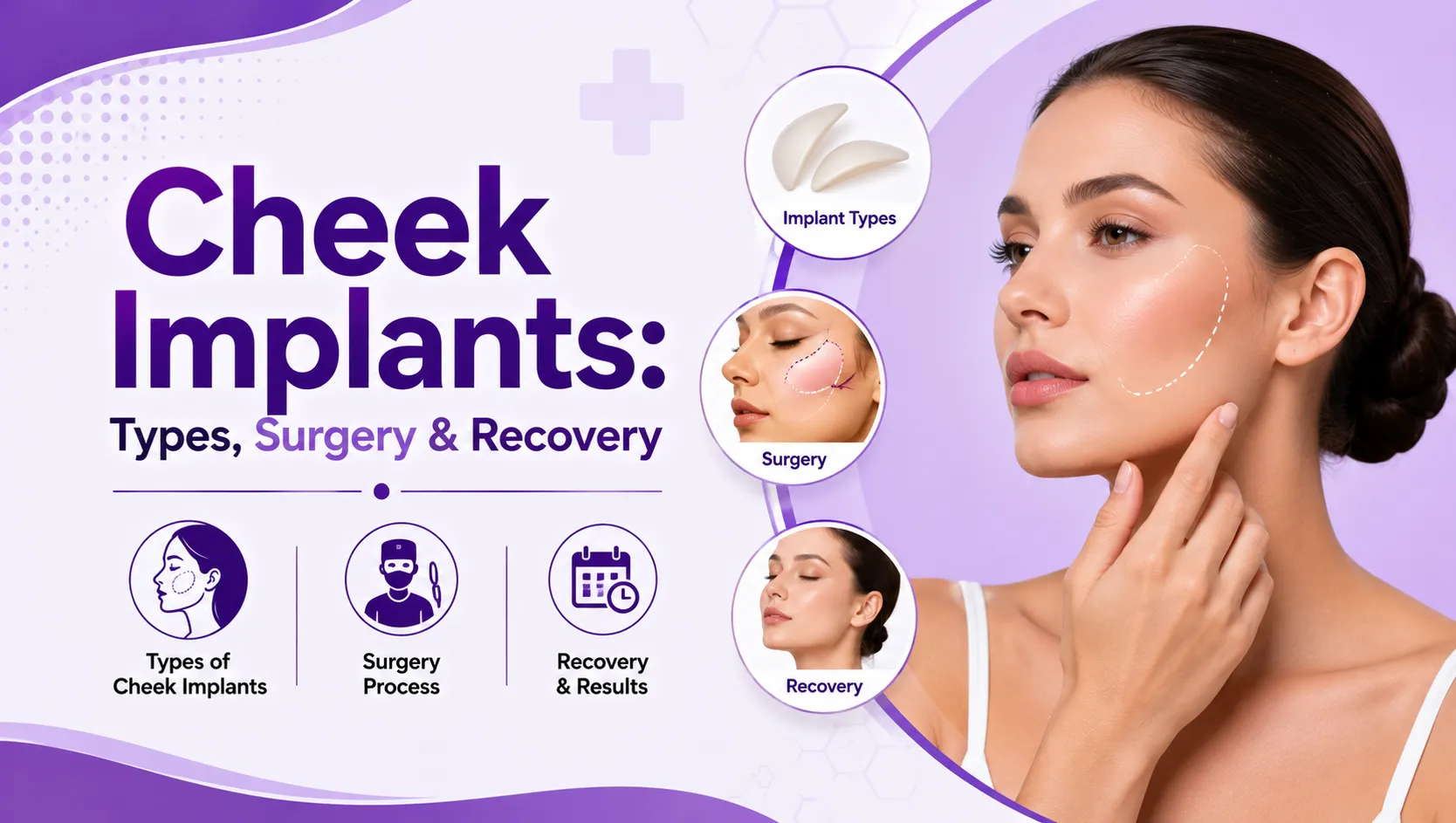
Cheek Implants: Types, Surgery & Recovery
Well-defined cheekbones can enhance facial balance and create a more youthful, sculpted appearance. While some people naturally have prominent cheekbones, others may have flatter facial features or experience volume loss with age, making the cheeks appear less defined over time.
For those looking for a long-lasting way to enhance their facial contours, cheek implant surgery offers a permanent solution. Unlike dermal fillers, which provide temporary volume, this procedure enhances cheekbone definition and facial symmetry, delivering natural-looking results that can last for many years.
In this blog, we'll explain what cheek implants are, the different types available, how the procedure is performed, recovery, benefits, possible risks, and whether cheek augmentation may be the right option for you.
What Are Cheek Implants?
Cheek implants are surgical implants used to enhance the shape, contour, and projection of the cheeks by adding volume to the cheekbones or the area beneath them. They help create a more balanced facial appearance and improve overall facial symmetry.
Most cheek implants are made from biocompatible materials such as solid silicone, although other materials like porous polyethylene may also be used based on the patient's facial anatomy and the plastic surgeon's recommendation.
Unlike dermal fillers, which provide temporary enhancement, cheek implants offer a long-lasting solution for improving facial contours. Although they are designed to last for many years, they can be revised or removed if required.
Cheek implants can help:
- Enhance cheekbone projection
- Restore facial volume
- Improve facial symmetry
- Create more defined facial contours
- Achieve better overall facial harmony
Who Is a Good Candidate for Cheek Implants?
Cheek implants are surgically placed medical implants designed to enhance the shape, volume, and definition of the cheeks. They help improve cheekbone projection, restore facial balance, and create a more sculpted appearance.
Most cheek implants are made from biocompatible materials such as solid silicone or porous polyethylene. The type of implant used depends on your facial anatomy, cosmetic goals, and your plastic surgeon's recommendation.
Unlike dermal fillers, which provide temporary volume, cheek implants offer a long-lasting solution for enhancing facial contours. While they are designed to remain in place for many years, they can be removed or revised if medically necessary or if aesthetic preferences change.
Cheek implants can help:
- Enhance cheekbone projection
- Restore lost facial volume
- Improve facial symmetry
- Create a more defined facial contour
- Achieve better overall facial harmony
Types of Cheek Implants
There are different kinds of cheek implants. The best option for you will depend on your specific goals and the structure of your face.
Malar Implants
These types of implants are the most popular of the cheekbone implant options.
They are placed over the cheekbone and aim to allow for more projection and refinement.
Best for:
- Lack of projection of the cheekbones
- Uneven midface contour
- Unbalanced facial profile
Benefits
- Augments cheekbone prominence
- Creates a defined facial structure
- Improves overall facial symmetry
Submalar Implants
Submalar implants are beneficial to individuals looking to add volume to their midface due to volume loss from aging or low natural midface volume.
These are placed under the cheekbone and help with hollow and sunken cheeks.
Best for:
- Sunken or hollow cheeks
- Volume loss from aging
- Low volume midface
Benefits:
- Restores a fuller look
- Softens the appearance of gauntness
- More symmetrical facial appearance
What Happens During Cheek Implant Surgery?
Before surgery, you'll have a consultation. During this appointment, the surgeon will:
- Go over your medical history
- complete a physical exam
- perform a facial assessment
- examine your cosmetic goals
- Choose the size and shape of your desired implants
- Take initial photos for your records
You'll also get guidelines regarding medication, smoking, and when to stop eating before your surgery date.
During surgery
Cheek augmentation surgery can be done using either local anesthesia with sedation or general anesthesia.
Small incisions are usually made inside the mouth (intraoral approach). In some cases, an incision may be placed just below the lower eyelid, depending on the surgical technique.
The implant is positioned over the cheekbone within a carefully created pocket to enhance facial contour and improve symmetry.
This operation usually takes from one to two hours.
Recovery After Cheek Implant Surgery
Swelling and bruising usually improve over the first few weeks, while your final facial contours become more visible as the tissues heal completely.
First week
You might have:
- Swelling
- Some bruising
- Tightness
- Slight pain
- Numbness
In case the cut is made inside the mouth, your doctor might advise you to consume soft foods for a few days and ensure proper oral hygiene.
Weeks 2‐4
During this time:
- Swelling continues to decline
- Bruising will clear
- Many patients can return to desk work within 7–14 days, although residual swelling may persist for several weeks.
- Facial structure is more evident
You should still refrain from intense exercise and activities until your surgeon gives you the go-ahead.
Final Results
You will see more progress after a few weeks, but the more conclusive results will not be there until the swelling goes down completely.
Once you are healed, the implants are more integrated with your overall facials and will be fuller and more defined.
Benefits of Cheek Implants
Patients who want a durable way to enhance their facial appearance opt for cheek implants.
The benefits of cheek implants include:
- Defined cheekbones
- Improved facial symmetry
- Added volume to the face
- Improved jawline and midface
- Face looks more youthful
- Longer-lasting results
- Higher confidence
- Improved features focused enhancement
When an expert surgeon does your procedure, the results appear as a natural enhancement.
Risks and Possible Complications
All surgeries have their risks, including cheek augmentation surgery.
The possible complications can be:
- Swelling
- Bruising
- Bleeding
- Infection
- Numbness for a while
- Movement of implants (rare)
- Asymmetry
- Scar formation (minor)
- Slow healing process
It is crucial to choose an experienced plastic surgeon and follow all the postoperative recommendations.
Cheek Implants vs Dermal Fillers
Many people considering facial enhancement wonder whether implants or fillers are the better option.
Dermal fillers are an excellent option for people seeking subtle changes without surgery. However, patients looking for permanent structural improvement often benefit more from cheekbone implants.
How Long Do Cheek Implants Last?
Longevity is one of the main benefits of cheek implants. Most implants do not need to be replaced.
However, some situations may require revision surgery.
- The implant moves
- An infection occurs
- The implant is affected by trauma
- The patient wants to change the size of the implant or have it removed
Most patients like the results of the surgery for many years when there are no major complications and the surgery is done with good technique.
How Much Does the Cost of Cheek Implants Cost?
In India, cheek implant surgery typically costs between ₹60,000 and ₹2,50,000, depending on several factors such as:
- Type of implant used
- Surgeon's expertise
- Hospital or surgical facility charges
- Anesthesia fees
- Complexity of the procedure
- Geographic location
Since every patient has unique facial anatomy and treatment goals, the most accurate estimate can only be provided after a personal consultation.
.Why Choose Dr. Preeti Yadav for Cheek Plastic Surgery?
Dr. Preeti Yadav is an expert at performing sophisticated aesthetic facial procedures that aim to improve your inherent beauty while ensuring a harmonious balance of the face.
The services include:
- Customization of the treatment plan
- Facial contouring surgery procedures expertise
- Advanced facial implant techniques
- Personalized facial analysis
- Focus on natural-looking facial proportions
- Aesthetic and balanced results
- Complete consultation and advice
- Post-operative care
- Safety and satisfaction-driven approach for the patients
If you want to add volume to your flat cheeks or to replenish the loss of volume due to aging, Dr. Preeti Yadav will develop custom treatment plans depending on your facial structure.
Conclusion
If you're looking for a long-lasting solution to enhance your facial contours and achieve more defined cheekbones, cheek implants can be an excellent option. The procedure is customized to your unique facial structure, helping create balanced, natural-looking results that complement your overall appearance. While recovery is an important part of the process, the results are long-lasting and highly rewarding when performed by an experienced plastic surgeon. If you're considering cheek implant surgery, consult Dr. Preeti Yadav, one of the best plastic surgeons in Gurgaon, to explore your options and receive a personalized treatment plan tailored to your aesthetic goals.
Frequently Asked Questions
1. What are cheek implants made of?
Most cheek implants are made from solid, biocompatible silicone or other medical-grade materials that are safe for long-term use.
2. Are cheek implants permanent?
Yes. Cheek implants are designed to provide long-lasting results and typically do not need replacement unless complications occur or aesthetic preferences change.
3. Is cheek implant surgery painful?
The procedure is performed under anesthesia, so you won't feel pain during surgery. Mild discomfort, swelling, and tightness are common during recovery and can usually be managed with prescribed medications.
4. How long does recovery take after cheek implant surgery?
Most patients can return to work within one to two weeks, while swelling continues to improve over several weeks. Final results are usually visible within a few months.
5. Will cheek implants look natural?
Yes. When the appropriate implant size and shape are selected and the surgery is performed by an experienced plastic surgeon, the results can look natural and complement your facial features.
6. Can cheek implants be removed or replaced?
Yes. Although they are intended to be long-lasting, cheek implants can be removed, replaced, or adjusted if medically necessary or if your aesthetic preferences change.
7. What is the difference between cheek implants and fillers?
Cheek implants provide permanent structural enhancement through surgery, while dermal fillers are non-surgical, temporary treatments that require regular maintenance sessions.
8. When can I return to work after cheek implant surgery?
Most people can resume desk work and light daily activities within one to two weeks, depending on the extent of swelling and the nature of their job.