

Breast Implants vs Breast Augmentation: What’s the Difference?
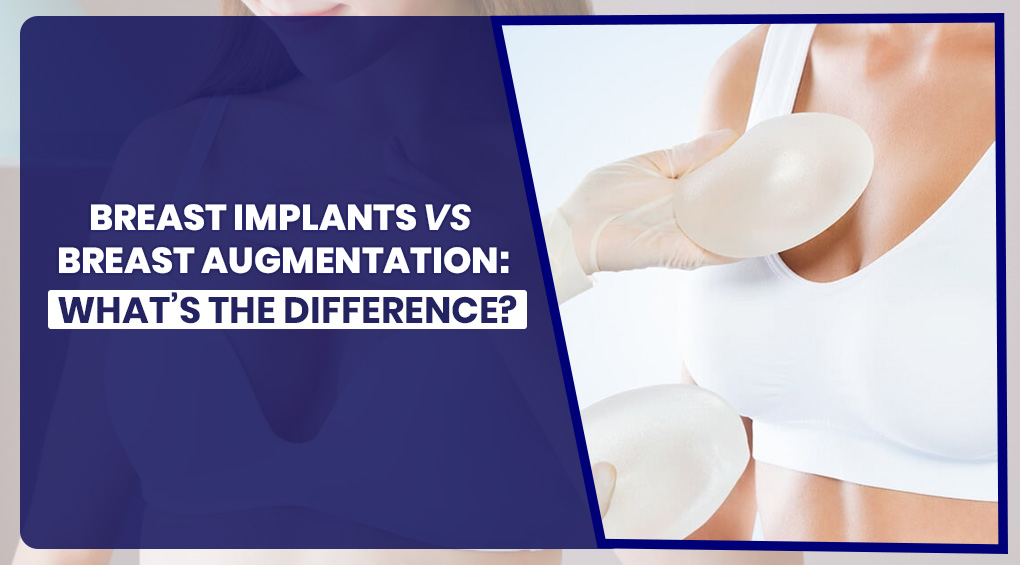
The terms breast implants and breast augmentation are associated with each other but differ in meaning. A breast implant refers to a silicone shell filled with either saline or silicone gel. It is surgically inserted underneath the breast tissue or muscle in a procedure aimed at changing the size of the breast.
On the other hand, breast augmentation is the surgical procedure that aims to resize or reshape the breasts. Implants are the “tools” needed, whereas augmentation is the procedure done.
In this blog, we will see the detailed explanation of both and the main differences between them, so you can choose the right option for you.
What are breast implants?
To put it simply, breast implants are prosthetic devices that aid in the expansion of breast size. Modern breast implants are made with silicone shells (sometimes they are covered with a thin polyurethane coating), which are filled with either sterile salt water (saline) or silicone gel. Both types have served in breast surgery for many years and are regarded as safe.
Implants come in various shapes such as round or teardrop/anatomical and textured patterns including smooth or textured; however, despite their differences, all share one attribute in common with each other: a silicone shell containing fluid.
Types of Breast Implants
Below are the types of breast implants you should know about:-
- Saline implants: These types have a silicone shell, which is filled with a sterile saline solution at the time of surgery. Generally, saline implants are placed empty and filled once in position. Saline implants are generally firmer than silicone ones, and can show slight rippling under the skin. Overall, saline implants do not feel as soft or natural as silicone gel implants.
- Silicone gel implants: These implants come pre-filled with a cohesive silicone gel. Many patients and doctors believe that silicone implants look and feel more natural than breast tissue. Since silicone gel is more viscous, small ruptures may go unnoticed - the gel tends to remain within the scar capsule, so without imaging, a leak might not be apparent.
- Structured implants: A more recent type contains an internal baffle that prosthetic and uses saline as a filler. Unlike other implants which claim to be filled with saline, these implants have nested shells which silicone acts as a lip. Women often report that structured implants feel softer than traditional saline implants.
What Is Breast Augmentation?
Breast augmentation, also known as augmentation mammoplasty, is an invasive procedure that adds volume to breasts through an implant or other substance. The operation is usually indicated to increase the size of small breasts to meet the preferences of the patient or restore lost breast volume after pregnancy, breastfeeding, significant weight loss, or aging. The procedure is performed to reshape the breast and address size disproportions between the two sides, along with some other asymmetrical conditions.
Reasons For Getting Breast Augmentation
Breast augmentation can be pursued for a number of unique personal, psychological as well as medical reasons. Common motivations include, but are not limited to the following.
- To Enhance size or restore: Breast augmentation surgery is chosen to add the size to small breasts as well as refill them to restore volume after pregnancy, breastfeeding, weight loss or age.
- To Correct Asymmetry: Women with breasts that are not of equal volume or shape can choose to undergo augmentation to even them out as one breast may grow differently than the other.
- Reconstruction after surgery: A lot of reconstructive surgery, alongside mastectomies due to cancer, will use implants to aid in restoring the shape of the breast to help women regain self esteem.
- Personal or Aesthetic goals: Women and even a small portion of men wanting to augment their breasts may do so to boost their self-image, or simply prefer to bust out of clothes with better fits.
In addition to looking at realistic outcomes, the surgeons alongside the patients can discuss each person’s expectations. Detailed consultations will include the feasible increment of increase, the optimum size of implant that will suit the body of the patient, shape, and the possible alternatives like fat grafting.
How Is Breast Augmentation Done?
Here’s how breast augmentation is done:-
- Implant-based augmentation: This is the most popular technique. The procedure is carried out under anesthesia. The surgeon does a small incision which can be located in the fold beneath the breast, the nipple areola complex, or the axilla. A pocket may be created beneath the breast tissue (subglandular placement) or under the chest muscle (submuscular placement).
- The implant selected is placed into the pocket created, held in the appropriate position, and the incision is closed. This procedure approximately takes 1 to 2 hours. Most patients staying for an overnight observation may be discharged the next day. Depending on the body type and preference of the surgeon, the muscle may or may not be placed over or under the tissue.
- Autologous fat grafting: In this method, a small volume of the patient’s fat from an area like the abdomen or thighs is removed using liposuction. The fat is cleaned and injected meticulously into the breasts in several passages or layers. There are no implants utilized as only natural fat is used.
- Compared to implants, fat transfer is typically associated with a modest increase in size. Frequently, a single session adds only a small amount of volume, and several procedures may be needed to achieve the desired results. Patients who desire subtle enhancement and wish to avoid implants can consider this method; sometimes to improve shape or coverage, surgeons combine fat grafting with a small implant.
After cosmetic surgery, patients may show signs of swelling, bruising and chronic discomfort for a couple of days. Pain and tightness in the area around the chest is invariably controlled by medication. Most are able to walk and move around as early as the first day and are back to full physical activities by around six weeks. It is common to take 1-2 weeks off work after surgery.
Initially, the breast may appear unnaturally high and feel hard; this persists for a few weeks, after which they soften and ‘settle’ into a more natural shape over the following three to four months. Scars will initially be reddish or purple, then fade over the following year. Recovery from a fat transfer augmentation is usually shorter and less painful than implant surgery (since only small incisions are made). Patients should still allow time for healing and may require further sessions as mentioned above.
There is a risk margin for all surgical procedures. Beside these, some important considerations include:-
- Capsular contracture: All breast implants will trigger the formation of scar tissue (capsule). In some cases, this capsule can tighten or shrink around the implant, creating breast firmness or distortion. This long term risk from breast implants is quite popular.
- Infection or significantly bleeding hemorrhage: Regardless of the surgery being performed, the possibility of infection acquiring or heavy bleeding following the surgery is still present. Surgeons take steps to reduce the possibility of infection (e.g., sterile technique, prophylactic antibiotics) but patients must be on the lookout for fever, unusual pain or discharge, or any mention of fever that might suggest a complication, in addition, follow the instructions on wound-care given by their surgeon.
- Deflation or implant rupture: Failure of an implant over a duration of time is also possible. The deflation of a saline breast implant will visibly occur if there is a leak, while, the saline is absorbed innocuously by the body. There can also be silent tears in silicone implants, where the contained gel is held by the scar capsule. Almost all ruptures require the surgical removal and replacement (most probably) of the implant. Although modern implants are more dependable, there is no such thing as everlasting implants. The likelihood exists that many women would require additional surgery years later to replace aging implants, fix some problem, or alter the results visually.
Closing Thoughts
With the utmost care and attention to detail for every patient, Dr. Preeti Yadav, a trusted and experienced plastic surgeon, has performed countless breast implantation and augmentation surgeries. Dr. Yadav recognized as the Best Plastic Surgeon in Gurgaon, combines the patient’s desired outcome along with well-being care to ensure that all patients achieve aesthetic results that are focused on their comfort.
Each treatment designed by Dr. Preeti is bound to the commitment to patient safety and the in-depth understanding of the anatomy which makes it personalized for every individual. Patients who seek her services can expect well defined as well as subtle changes that are natural and well planned, along with expert guidance that ensures unparalleled care.